



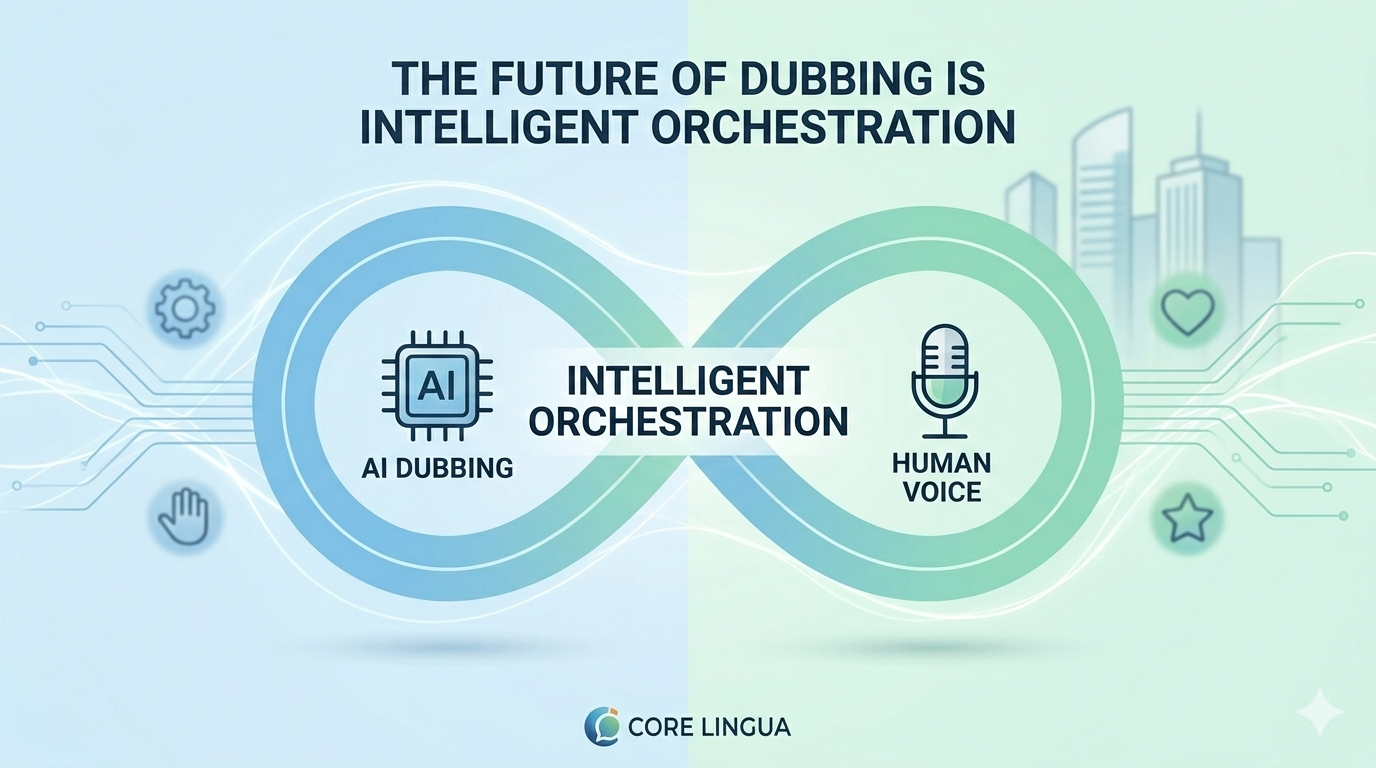
As global content pipelines scale, one question keeps coming up: Should we use AI dubbing, human voice-over, or a hybrid model?
For SaaS, E-Commerce, and EdTech teams shipping multilingual demos, onboarding, support, and training content, this is now an operational decision—not a trend debate.
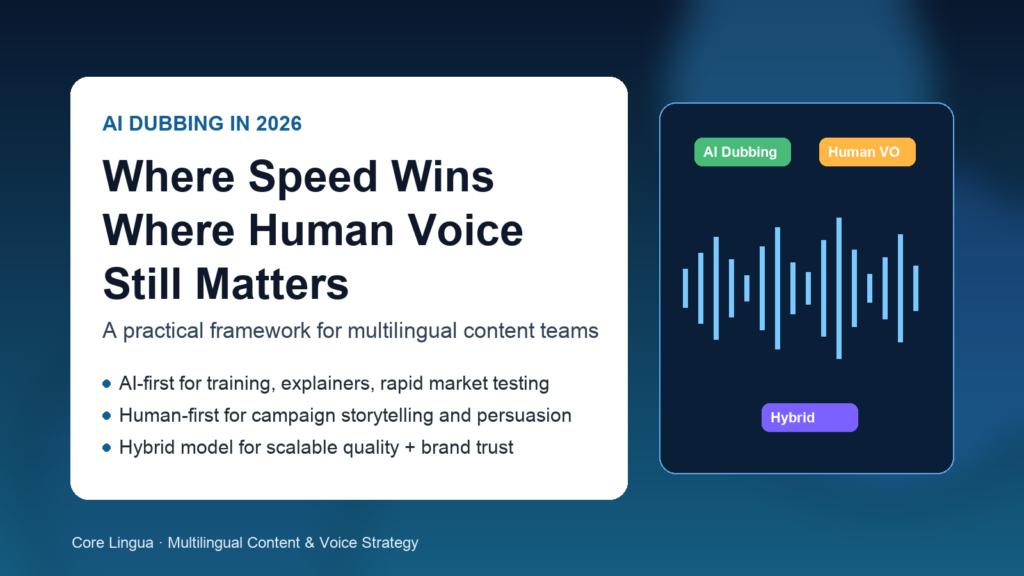
TL;DR for busy teams
- Use AI dubbing for high-volume, fast-turnaround utility content.
- Use human voice-over for trust-critical and brand-defining communication.
- Use a hybrid workflow for most mature localization programs.
- Optimize for outcomes: clarity, credibility, and conversion.
Where AI dubbing works best
1) Product tutorials and feature walkthroughs
AI dubbing performs well for UI walkthroughs, release explainers, setup videos, and help-center recordings where precision matters more than emotional performance.
2) Catalog-level localization for E-Commerce
For repetitive SKU content, AI supports fast scaling across markets when scripts and glossaries are controlled.
3) Internal training and evergreen education
For frequent updates (compliance, onboarding, orientation), AI reduces turnaround and keeps delivery consistent.
Where human voice-over still wins
- Brand films, campaign hero assets, emotional storytelling
- Executive communication and trust-sensitive messaging
- High-stakes learning content requiring pedagogical nuance
- Premium markets where delivery quality is part of brand perception
Decision Framework: AI vs Human vs Hybrid
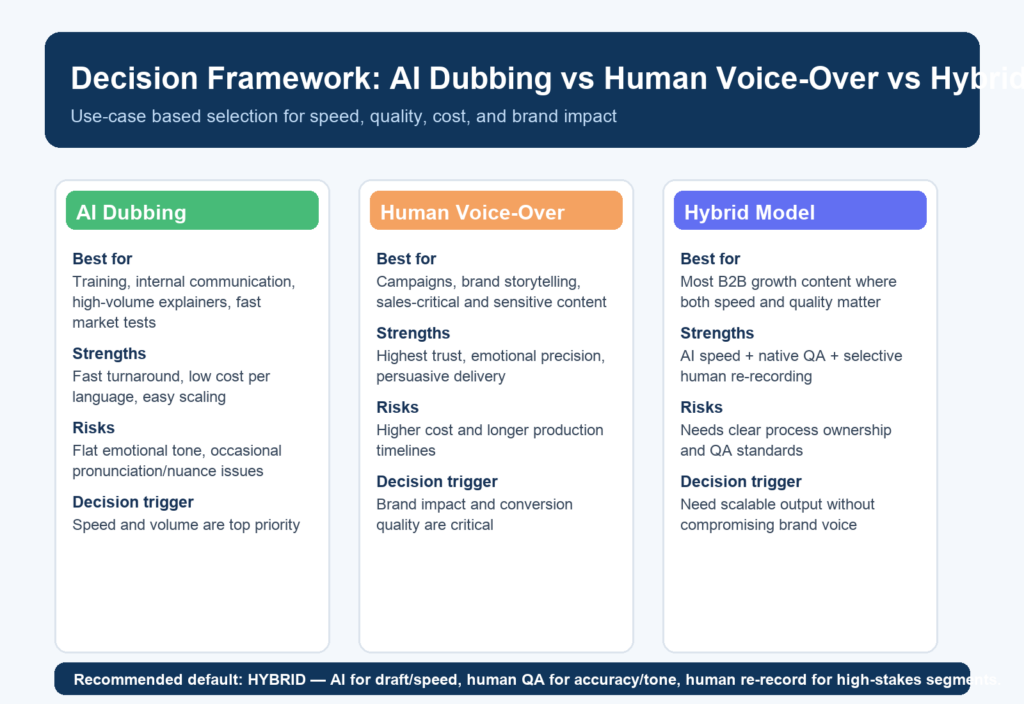
- Classify business risk: low / medium / high impact.
- Score voice sensitivity: complexity, emotional nuance, brand criticality.
- Validate language-market fit with native reviewers.
- Select production model: AI-first, hybrid, or human-first.
- Apply quality gates: terminology, pronunciation, timing, native QA.
Recommended operating model in 2026
The most effective strategy is rarely all-AI or all-human. It is intelligent orchestration:
- AI for speed and repetitive throughput
- Human experts for adaptation, nuance, and final QA
- Unified standards for terminology, tone, and brand consistency
Final takeaway
The future of multilingual video is not AI versus humans. It is AI plus humans, applied intentionally.
When you map content risk, voice sensitivity, and market fit correctly, AI dubbing becomes a force multiplier. Without that framework, it becomes expensive rework.
Ready to scale multilingual content without sacrificing quality?
Core Lingua helps teams design dubbing workflows that combine human quality with AI speed.
Talk to Core Lingua to build a dubbing strategy that scales globally and still sounds locally right.